
The Pencil & Paper Tax: 5 Desmos Hacks to Auto-Solve Digital SAT Math

By Lauren Jones • 5 min read • Published
Are You Paying the Pencil & Paper Tax?
Roughly 70% of the Algebra questions on the Digital SAT can be solved faster in Desmos than with a pencil. Yet most students walk into test day using the exact same multi-step methods taught in their high school math classes.
When a student attempts 44 adaptive math questions using classroom algebra under timed pressure, two things happen:
- They run out of time on Module 2 and leave high-value questions blank.
- They drop easy points to careless arithmetic errors while moving terms across equal signs.
The Digital SAT doesn't reward neat handwriting or showing your work. It rewards speed, accuracy, and efficiency.
| Aspect | High School Math Class | Digital SAT Math Section |
|---|---|---|
| Goal | Show all work for partial credit. | Lock in the correct answer as fast as possible. |
| Method | Manual multi-step algebra. | Calculator-driven visual shortcuts. |
| Reward | Thoroughness and neat handwriting. | Speed, precision, and time management. |
Here is how swapping manual math for 5 Desmos Secrets instantly reclaims lost time and protects your student's score ceiling.
Secret #1
The X-Intercept Solver(Skip Fraction Arithmetic)
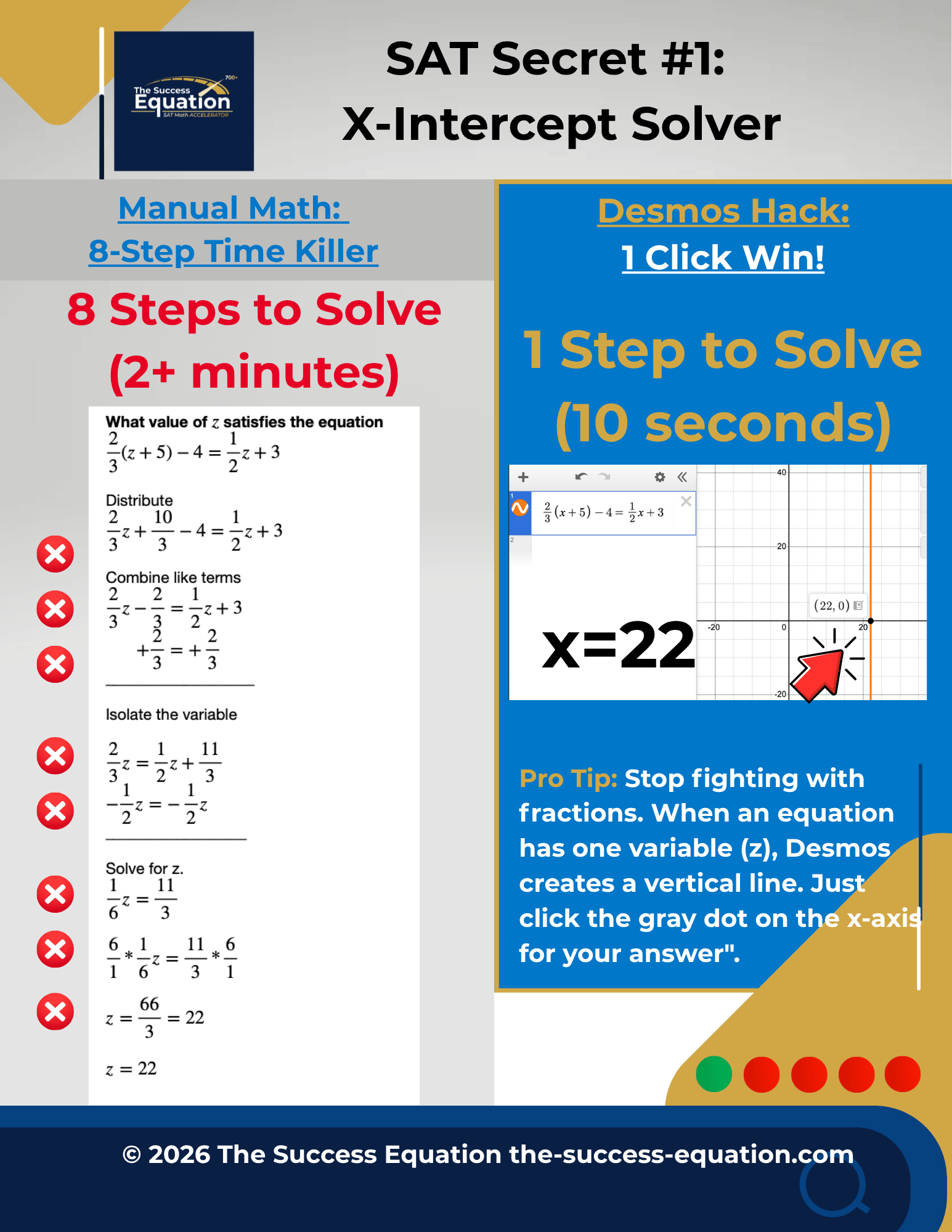
When faced with single-variable linear equations loaded with fractions, students usually spend 2+ minutes distributing terms, finding common denominators, and isolating variables.
The Problem
Manual Math: 8-Step Time Killer
Distribute fractions, combine like terms, find a common denominator of 6, subtract ½z, and multiply by the reciprocal.
2+ minutes, high error risk
Desmos Hack: 1-Click Win
- Type 2/3(x+5)-4 = 1/2(x)+3 into Line 1.
- Desmos renders a vertical line at x = 22.
- Click the gray dot on the x-axis.
10 secondsx = 22
Secret #2
Parabola Precision(Ditch the Quadratic Formula)
Physics-style projectile motion questions love testing height over time using complex quadratic formulas.
The Problem
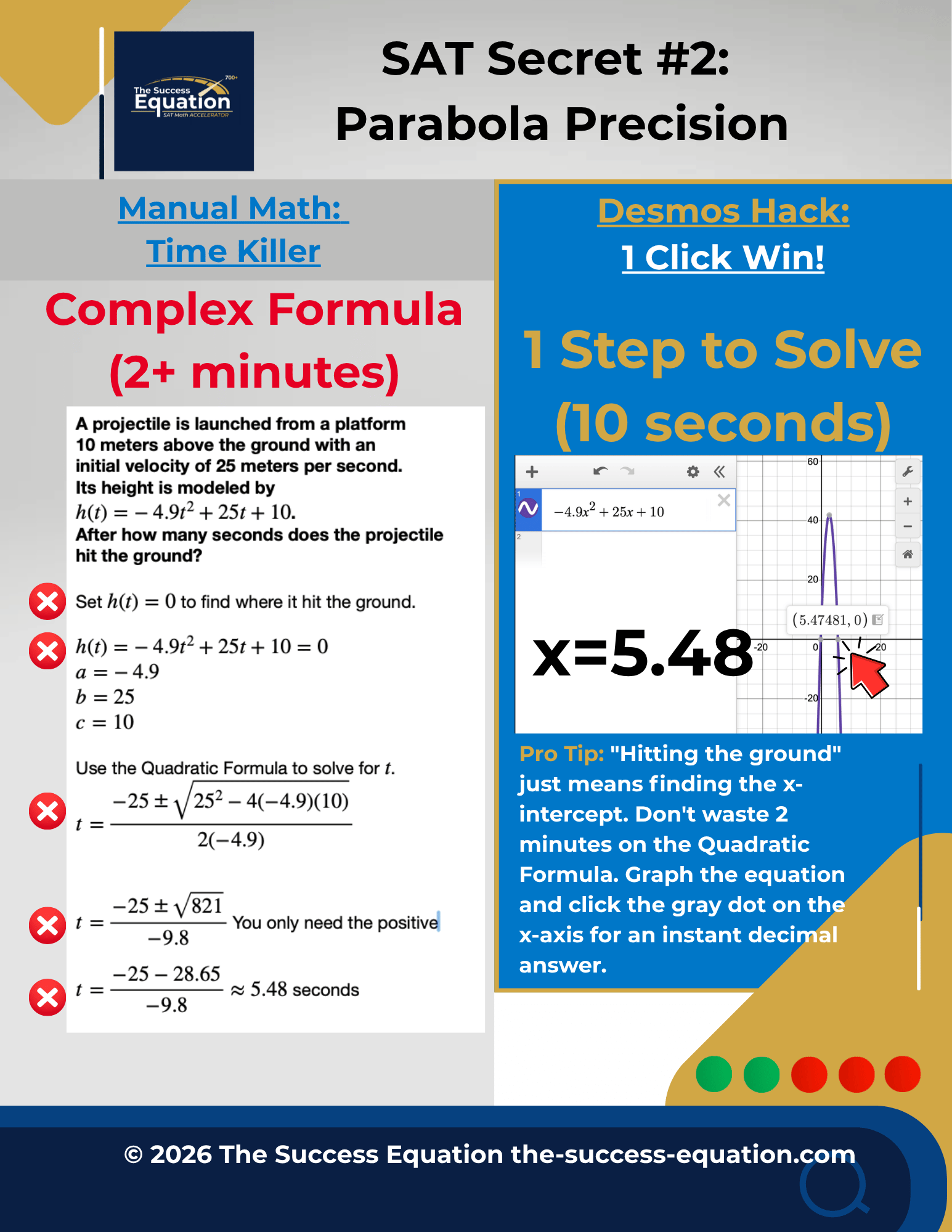
A projectile is launched from a platform 10 meters above the ground. Its height is modeled by h(t) = −4.9t² + 25t + 10. After how many seconds does it hit the ground?
Manual Math: Time Killer
Plug a = −4.9, b = 25, and c = 10 into the Quadratic Formula, evaluate the square root, and discard the negative value.
2+ minutes
Desmos Hack: 1-Click Win
- Type -4.9x^2 + 25x + 10 into Desmos.
- Tap the gray dot where the parabola crosses the positive x-axis.
10 secondsx ≈ 5.48 seconds
Secret #3
The Slider Hack(Conquer Multiple Unknowns)
When an SAT question includes multiple variables (a, b, and x), students panic because they think they need to solve complex systems.
The Problem
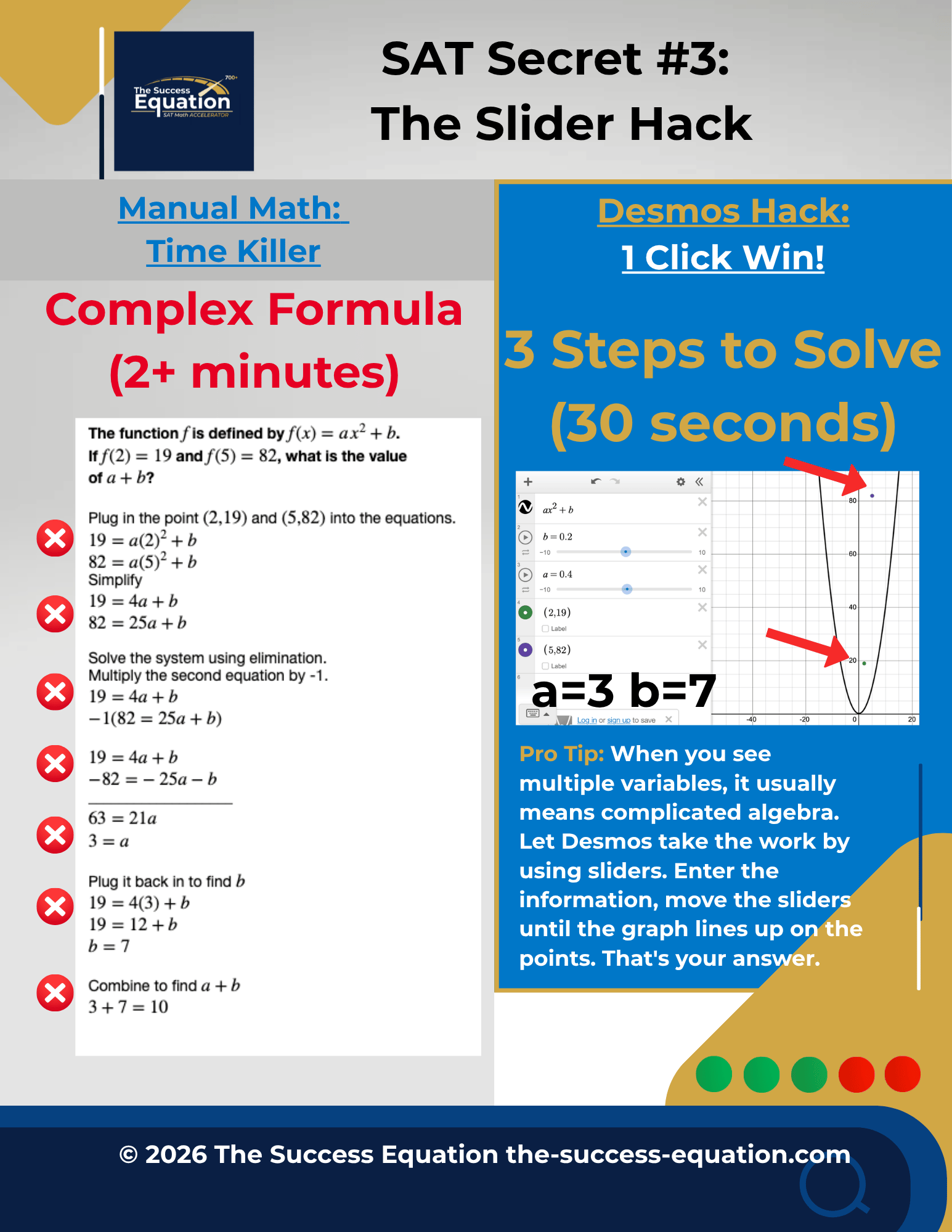
The function f is defined by f(x) = ax² + b. If f(2) = 19 and f(5) = 82, what is the value of a + b?
Manual Math: Time Killer
Substitute both points, build a system of two equations, eliminate b, solve for a, then plug back in to find b.
2+ minutes
Desmos Hack: 30-Second Solution
- Type y = a*x^2 + b into Line 1 and click Add Sliders for a and b.
- Plot the points (2, 19) and (5, 82) on lines 2 and 3.
- Adjust the sliders until the curve passes through both points (a = 3, b = 7).
- Add them together: 3 + 7 = 10.
30 secondsa + b = 10
Secret #4
System Intersections(Stop Doing Elimination)
Linear systems show up constantly in the high-yield Algebra section.
The Problem
Manual Math: 8-Step Time Killer
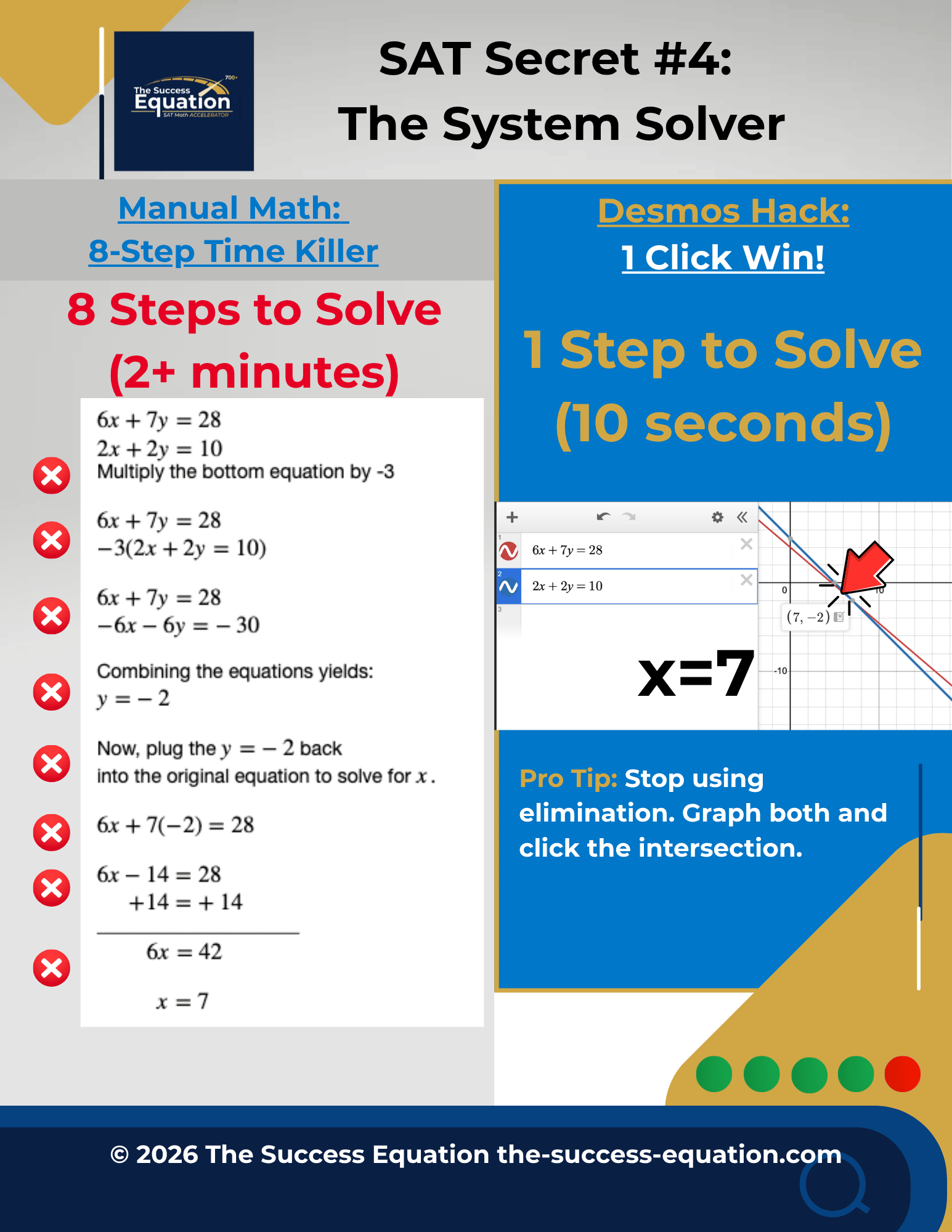
Multiply equations by negative factors, align terms, eliminate a variable, and substitute back in to solve for the other.
2+ minutes
Desmos Hack: 1-Click Win
- Type 6x + 7y = 28 in Line 1.
- Type 2x + 2y = 10 in Line 2.
- Click the intersection point: (7, −2).
10 seconds(7, −2)
Secret #5
The Regression Revolution(Data Tables to Equations)
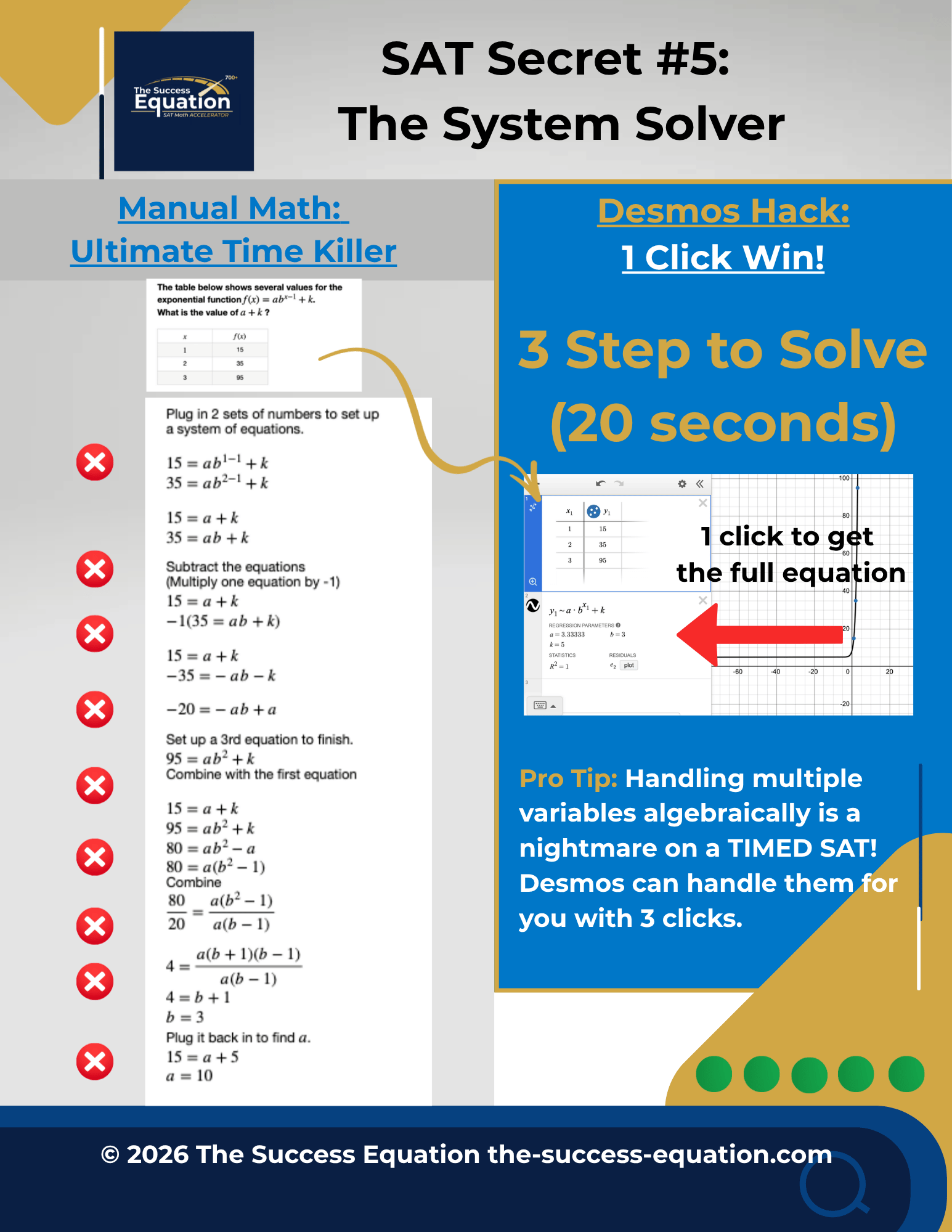
When the SAT provides a table of data points and asks for the matching exponential or quadratic equation, manual algebra requires solving multi-variable systems.
The Problem
The table shows values for the exponential function f(x) = ab^(x−1) + k: f(1) = 15, f(2) = 35, f(3) = 95. What is the value of a + k?
Manual Math: Ultimate Time Killer
Set up three equations from the table, subtract to eliminate k, factor, divide to isolate b, then plug back in for a and k.
3+ minutes
Desmos Hack: 3-Step Solve
- Insert a Table in Desmos and enter the x₁ and y₁ values.
- Type y1 ~ a * b^(x1 - 1) + k in the next line.
- Desmos instantly calculates a, b, and k.
20 secondsa, b, and k in one click
Don't Leave Points (or Scholarship Money) on the Table
Mastering these 5 Desmos hacks is the first step toward breaking past score plateaus. But shortcuts alone are only part of the equation.
To reach 700+ on SAT Math, students must pair calculator efficiency with pattern recognition, pacing stamina, and strategic decision-making under time pressure.