
Why Your Teen is Stuck in the 500s on Digital SAT Math (And the Module 1 Trap)

By Lauren Jones • 6 min read • Published
The Hidden Mechanics of the Digital SAT
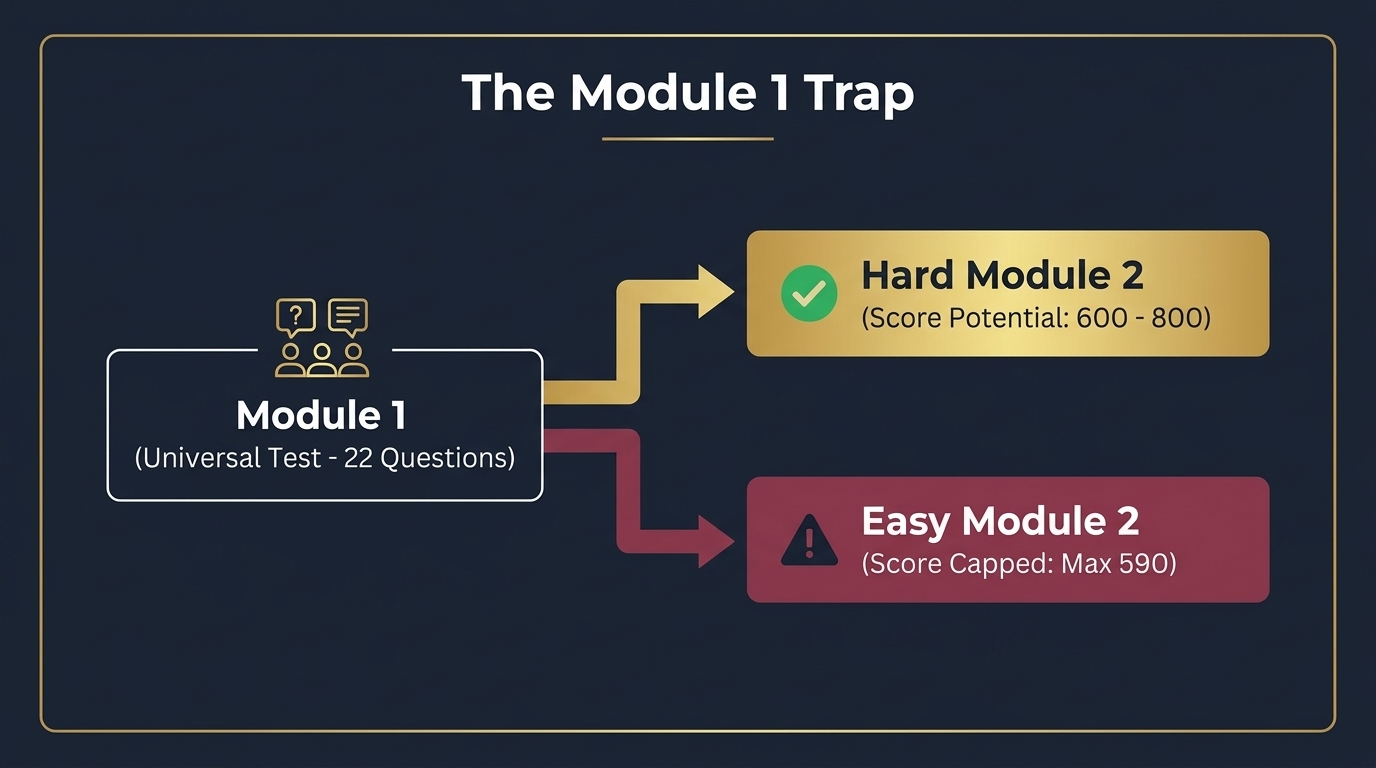
Students scoring between 500 and 580 rarely have a broad math problem. In most cases, they're hitting an adaptive routing penalty built into the structure of the test itself.
The Digital SAT Math section is multi-stage adaptive:
- Module 1 (22 questions): A universal test with mixed difficulty. Every student sees the same level of challenge.
- Module 2 (22 questions): Your Module 1 performance decides whether you're routed to the Hard Module 2 or the Easy Module 2.
Here's the part most parents never hear: a handful of careless errors in Module 1 can cap a student's total potential score below 600, no matter how well they perform on the Easy Module 2.
The 520 Score Trap
Standard high school math habits (long-form algebra, distributing fractions by hand, manually finding common denominators) create time friction. Under exam pressure, that friction turns into careless errors, and in Module 1, careless errors are expensive.
Take a typical Module 1 linear equation:
Manual Math: Careless Error Risk
- Distribute fractions across parentheses manually
- Find common denominators (12) across all terms
- Move variables and constants across equal sign
- Multiply by reciprocals to isolate x
2+ minutes spent • High risk of sign/arithmetic error
Desmos Method: Fast & Flawless
- Type 3/4(x-2)+5 = 1/3x+9 directly into Line 1 of Desmos
- Look at the vertical line rendered on the coordinate grid
- Click the gray x-intercept dot to reveal x = 13.2
12 seconds spent • 0% arithmetic error risk
The 70% Solution: Focus Where Points Live
The College Board's official domain weighting shows exactly where to invest prep time:
- Algebra & Advanced Algebra: 70% of the exam (~30 questions). The primary score threshold.
- Problem-Solving & Data Analysis: 15% (~7 questions). Covered efficiently in strategy labs.
- Geometry & Trigonometry: 15% (~7 questions). The final security layer.
Algebra & Advanced Algebra 70%
~30 questions
Problem-Solving & Data Analysis 15%
~7 questions
Geometry & Trigonometry 15%
~7 questions
3-Point Diagnostic Checklist for Parents
Module 1 Audit
Module 1 Pacing: Is your teen running out of time on Module 1 with 4–5 questions remaining?
Mental Fatigue: Are they losing points to simple sign or fraction errors on the first 10 questions?
Calculator Habits: Are they using scratch paper for linear equations that Desmos solves in 10 seconds?
If you answered YES to any of these, your student has a Module 1 routine issue that practice test grinding alone cannot fix.